



Is There Any Different Classes of Fire? Understanding Fire Types the Simple Way
Yes, there are different classes of Fire. When people hear the word fire, they often imagine a single kind of danger. But in reality, not all fires are the same — and neither the methods used to control them. In general, fires are classified into five main classes: A, B, C, D, and K (or F). Each class is defined by the type of material that’s burning and requires a specific way to handle it.
That’s why fire classification exists.
It helps us understand what is burning so we can respond correctly and avoid turning a small incident into a bigger disaster.
Let’s break down the different classes of fire in a simple, clear, and practical way.
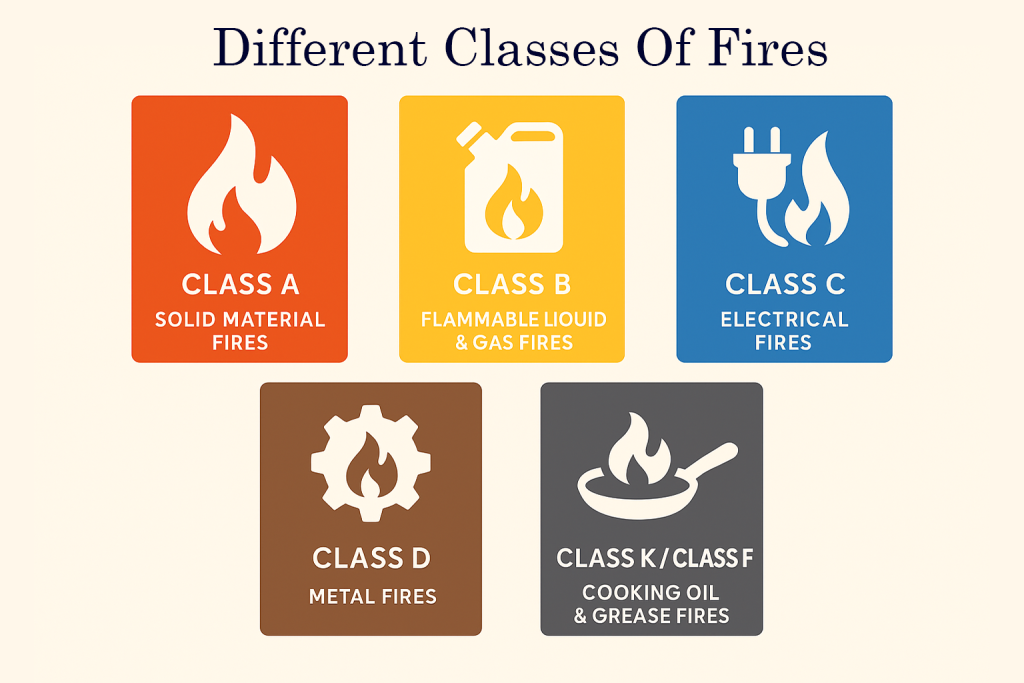
Class A – Solid Material Fires
These are the fires that start from everyday solid materials like wood, paper, cloth, plastic, rubber, or trash.
If it burns and leaves behind ash, it usually falls under Class A.
Where you’ll see them: Homes, offices, schools, warehouses — basically anywhere.
Best way to control: Water, foam, or dry chemical extinguishers.
Class B – Flammable Liquid & Gas Fires
Class B fires involve liquids or gases that ignite easily, such as petrol, diesel, kerosene, paints, solvents, and LPG.
These fires can spread very quickly because the fuel itself moves.
Important: Never use water — it can make the fire spread even faster.
Best way to control: Foam, CO₂, or dry chemical extinguishers.
Class C – Electrical Fires
These are fires that begin due to electrical issues — like short circuits, faulty appliances, overloaded wiring, or sparking machinery.
Electrical fires cannot be approached the same way as a normal fire.
Using water can be extremely dangerous due to conductivity.
Best way to control: Non-conductive extinguishers such as CO₂ or dry powder.
Once the electricity supply is cut, the fire may convert to a Class A fire.
Class D – Metal Fires
Class D includes fires involving combustible metals such as magnesium, titanium, lithium, and sodium.
These fires burn at extremely high temperatures and can react violently with water or standard extinguishers.
Where seen: Industrial units, manufacturing plants, laboratories.
Best way to control: Special Class-D dry powder extinguishers only.
Class K / Class F – Cooking Oil & Grease Fires
These are common in commercial kitchens, restaurants, and hotels, especially around deep fryers.
They happen when cooking oils and fats overheat and burst into flames.
Trying to throw water on these fires can make the flames rise dramatically and spread.
Best way to control: Wet chemical extinguishers, designed to cool the oil and form a protective layer.
Why Understanding Fire Classes Matters
Knowing the type of fire isn’t just technical knowledge — it’s life-saving awareness. Understanding fire classes helps you:
- Choose the correct fire extinguisher
- Prevent small fires from becoming uncontrollable
- Train staff effectively in workplaces or industries
- Keep kitchens, offices, and factories safer
- Avoid mistakes that cause fire spread or accidents
A small amount of right knowledge can prevent a large amount of damage.
Conclusion:
Different classes of fire may look similar at first glance, but each one behaves differently and needs a specific method to control it safely. Understanding these classifications helps you choose the right extinguisher, avoid dangerous mistakes, and respond more confidently during emergencies. Whether it’s a home, office, kitchen, or industrial setup, knowing what type of fire you’re dealing with can prevent major damage and protect lives.
Fire safety begins with awareness — and taking the right action starts with knowing the class of fire in front of you.
Explore Sai BioCare’s Industrial & Domestic Fire Fighting Systems to ensure your space is fully protected with the right solutions — because the right equipment makes all the difference.